US Regular Utility Patent Application US 16/726,742 has been filed - as of Dec 24, 2019. Due to the pressing problem of climate change, I am sharing this publicly and not waiting for the USPTO to publish.
This disclosure represents a new direction for cooling and heating and other uses for heat transfer. This patent application outlines a selective surface that works generally in the infrared range. It does what has never been done, which is to move heat from a cooler source to a warmer source without external energy or work input.
"You can't do that!" - is the usual response. But yet, I've shown this to physicists and engineers, and they can't answer why. The ideal device is just two plates that radiate towards each other with an array of radiant concentrators between them. It is very simple conceptually. So if this doesn't work, it shouldn't take a person who understands the material more than a few mintues to put their finger on why. And yet, and so far, no one has! So, a challenge follows below.
The following links open PDF files for the US Utility Patent Application:
Selective Surface Specification - RPA
Drawings:
Challenge:
The 2nd Law of Thermodynamics is an empirical law. One interpretation of the law states that if no known devices exist that can move heat from a cooler source to a warmer source with no external energy input, then none can be made. A common assumption is that "cooler" and "warmer" can be determined from temperature. Yet the definition of heat is actually: "In thermodynamics, heat is energy in transfer to or from a thermodynamic system, by mechanisms other than thermodynamic work or transfer of matter." In this device heat is transferred by radiation, and thus by photons. The energy transferred is the number of photons times the average energy per photon. So, a surface with a larger area is putting out more heat than a smaller surface at the same temperature. This device challenges the particular interpretation that "cooler" and "warmer" can be determined solely by the temperature of the sources, and what is assumed from that.
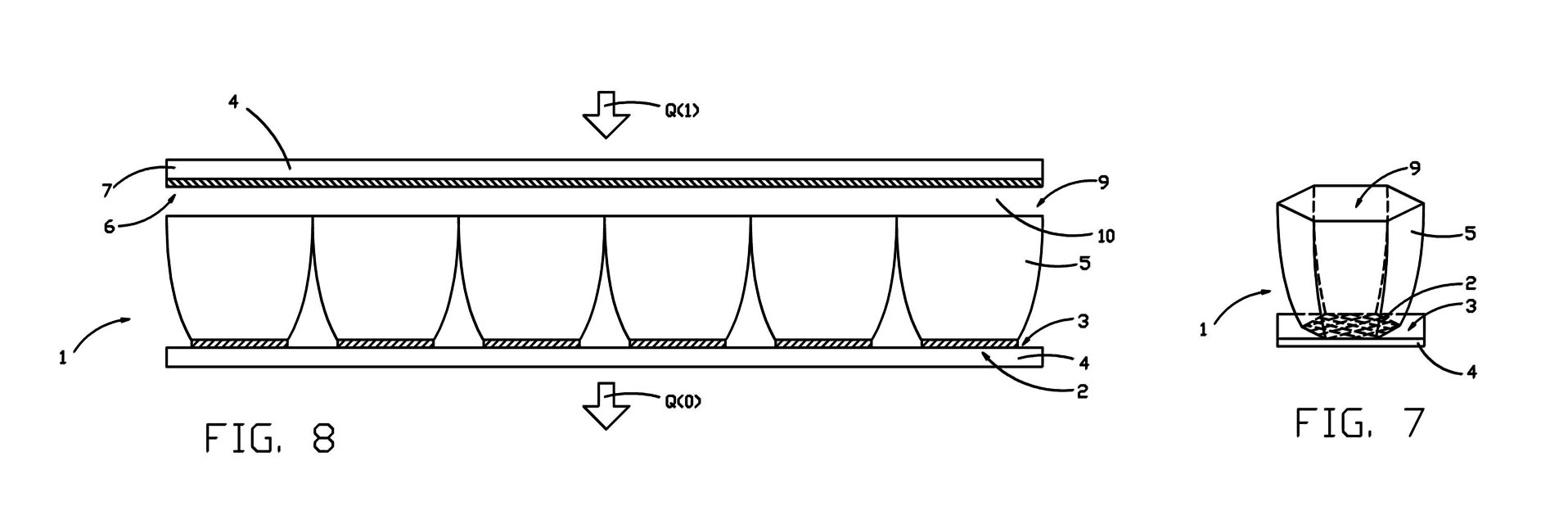
The device comprises just two objects radiating at each other, with another device in between them. The device in between is a compound parabolic concentrator (CPC), which is a radiant concentrator - similar to a lens, but non-imaging. The CPC is filled with, or comprises a transparent material. (See the drawing above, which shows a 2D cross-section.) Let's look at the ideal case. So, assume that the materials are perfect. This means the absorptive (black) surfaces are blackbodies, and the others (apart from the CPC) are perfectly reflective - white bodies. The CPC would be 100% transmissible, with a 1.5 index of refraction. To name the parts, the top object is the emissive object 7, and the black surface on the bottom of it is the emissive surface 6. The concentrator is the CPC 5, and the absorber at the bottom is the receiver 2. The top of the CPC is the aperture 9. Assume these objects are in a vacuum, so there is no conduction. Since the very top and bottom surfaces are 100% reflective, there would be no energy transfer with whatever enclosure surrounds it. Rays of radiant energy emitted by the emissive surface 6 reach the aperture 9 coming at angles from a 180 degrees range with respect to a y-axis, which points downward on the page. Due to the index of refraction, the range of angles lowers to about 84 degrees (with a 42 degree half angle) upon entering the CPC. (Both glass and potassium bromide have indexes of refraction about 1.5, and that gives an approximately 42-degree critical angle, so these are reasonable numbers.) Now there are two methods to handle the sides of the CPC. One method is that the CPC has reflective sides, and in this ideal case - 100% reflective. In this, case, there is no emittance. Also in this case, all rays that enter the CPC reach the bottom provided the half acceptance angle of the CPC is less than or equal to the critical angle, and all radiant rays coming from the emissive surface are 100% absorbed by the receiver, as is the definition of a blackbody. In this ideal case, there is more radiation that will be absorbed at the receiver than the receiver emits back at the emissive object. This is true for a range of temperature differences that end when the emissive object is somewhat cooler than bottom selective surface. (The other method to handle the sides of the CPC is that the CPC is completely comprised of the transmissible material. This method relies on internal reflection. If it does, and all of the vectors that enter internally reflect, then the angle at the bottom of the sides of the CPC can’t exceed the critical angle for all rays to reach the bottom. I’m not going into detail here, but there can be some concentration, which again leads to a selective surface in the ideal case.) Now let’s assume an initial condition where the temperature of the emissive object on top is the same as the selective surface on the bottom object. At this temperature, both objects emit the same radiation flux. In this case, the EMF energy radiated per area is the same. But the total area of the emitting surface of the top emissive object is much larger, so it emits more total radiation energy at the receiver than the receiver emits back at it. This is due to the CPC concentrator. In this ideal example, all the radiation emitted from the top emissive surface that enters into the CPC reaches and is absorbed by the receiver. The flux is concentrated and increased by the concentrator. The concentrator is similar to a concentrator in one direction, and a diffuser in the other. Unlike nozzles and diffusers in fluid flows, radiation flows both directions simultaneously.The 2nd law is generally interpreted as stating that this system will be in thermal equilibrium if no net energy is transferred between the two objects, AND the two objects are at the same temperature (which is the initial condition here). However, for this to be true of this device, either radiant energy has to be destroyed at the receiver, as its absorption of a higher flux of radiant energy would have to match the emittance, which occurs at a lower relative flux. Or energy has to be created at the emissive surface.
In other words, there are three choices here. First, this device invalidates the first law of thermodynamics for this condition. Second, it invalidates the second law. Or third, it is merely that many have made an assumption about the second law that is not valid in all circumstances- particularly for two bodies radiating at each other with a radiant concentrator between them, which do not comprise a thermodynamic cycle.
On Wikipedia, it is stated: “Thermal equilibrium is achieved when two systems in thermal contact with each other cease to have a net exchange of energy. It follows that if two systems are in thermal equilibrium, then their temperatures are the same.” (From https://en.wikipedia.org/wiki/Thermodynamic_equilibrium)
Well, the problem here is the statement: “It follows…” In the above ideal device, it does not follow. So it is a wrong assumption. It is an assumption due to the behavior of known materials. But "it follows" is not proof that a metamaterial can't be invented that behaves differently.
According to P.M. Morse: "It should be emphasized that the fact that there are thermodynamic states, ..., and the fact that there are thermodynamic variables which are uniquely specified by the equilibrium state ... are not conclusions deduced logically from some philosophical first principles. They are conclusions ineluctably drawn from more than two centuries of experiments." (Morse, P.M. (1969), p. 7. From https://en.wikipedia.org/wiki/Thermodynamic_equilibrium#cite_note-23)
So, not only is this interesting as a challenge to some thermodynamic statements that have been made, but it is of real importance to the world. The implications are massive for a device that can move heat energy from a cooler temperature source to warmer without external energy input. Please share it to anyone you think would be interested, as I would like to hear their feedback.
Regarding the potential: At 295 degrees K (72° F) an emissive surface with an emissivity of 1 emits 429 W/m^2. If Germanium is used for the CPC, with an index of refraction of 4, an ideal three-dimensional Germanium CPC will have a concentration ratio of 16. According to the Fresnel equations, 39% of the radiation will be reflected back at the emissive surface (but this may be less) at the interface of Germanium and the vacuum and only 262 W/m^2 enters the CPC. If it is assumed that the device has the initial conditions, as above, wherein all elements have an initial temperature of 295° K and the emissive surface is one cubic meter, then the receiver absorbs 262 Watts, while emitting only 27 Watts (429*(1/16)). Thus, this ideal device will initially move 235 Watts/m^2 (262-27). (Okay, I'm ignoring that some of the 27 W are reflected back at the receiver at the top dielectric surface - raising the watts moved.)
The temperature of the two objects/plates will diverge until the net energy transferred between the two is zero. If the top plate is fixed at 295° K, the temperature of the bottom object/plate will rise to the amount where 1/16 of a square meter radiates 429 W/m^2. From the Stefan-Boltzmann equation, the temperature works out to 590° K (602° F). Thus, at thermal equilibrium for this device and temperatures, there is a temperature difference of 295° K!
Regarding the real-world potential, Parson's black paint has a listed emissivity of 0.98 (98%), with many materials at, or above 0.90. I have also seen reflective surfaces as low as 0.02 (2%), although 0.05 (5%) is more attainable. For the material of the CPC, the transmissibility in the mid-infrared range of potassium bromide and germanium are also both excellent, particularly because the ideal size of the CPC is very small. Germanium, in particular, has a very high index of refraction, which would be excellent for this device. Also, germanium with an AR coating has a very high transmissibility of 96%+. Other suitable materials have indexes of refraction at 1.4 or above, which also would work quite well. Thus, it is not hard to imagine that a real-world device could achieve a fair percentage of the ideal values given here.
Abstract
The present invention relates to a heat transfer device or system for the use of moving heat energy, which is generally cooling or heating. The device or system comprising at least one selective surface (1), wherein the selective surface comprises at least one radiant concentrator or lens (5) and at least one conductive material (4) comprising at least one receiver (2). The selective surface exchanges radiant energy with at least one emissive object (7), whereby net heat energy is transferred through radiant energy exchanged between the emissive object and the selective surface.
Prior Art
Prior art references disclose selective surfaces that have different absorption and emission properties between different bands of radiation. Selective surfaces are in use in solar collectors that are highly absorbent to visible light from the Sun, but are much less absorbant and emissive to infrared radiation. This enables solar collectors to absorb and keep a high amount of heat.
Selective surfaces have also been recently developed for the use of cooling. These selective surfaces are highly reflective to solar radiation, while still emitting significantly in the infrared range to cool by radiating heat energy out to the extreme cool of space.
These existing selective surfaces differ from the present invention. The selectivity they possess is between different radiation bands, and they do not operate within one narrow range. Further, they move heat energy from hot to cold. Further, they can't be layered to maintain a higher temperature differential, as can the selective surfaces of the present disclosure.
Many suggestions are contained within the present patent disclosure, and there may be many obvious alternative embodiments. CIP's (Continuation in Part) applications filled with the present inventor listed as a co-inventor are entitled to have the benefit of the present application to overcome obviousness objections. Thus, please contact temple89450 [at] hotmail.com if you would like to work together to push this new method forward.